The operations center, without the operations center
Most guard companies can't afford a staffed dispatch desk. Watchbill puts the parts that matter — where everyone is, who's responding to what, who needs help, and a record of every conversation — on one screen, and in the owner's pocket.
Free 30-day trial with no card required. $7/guard per month, everything included.
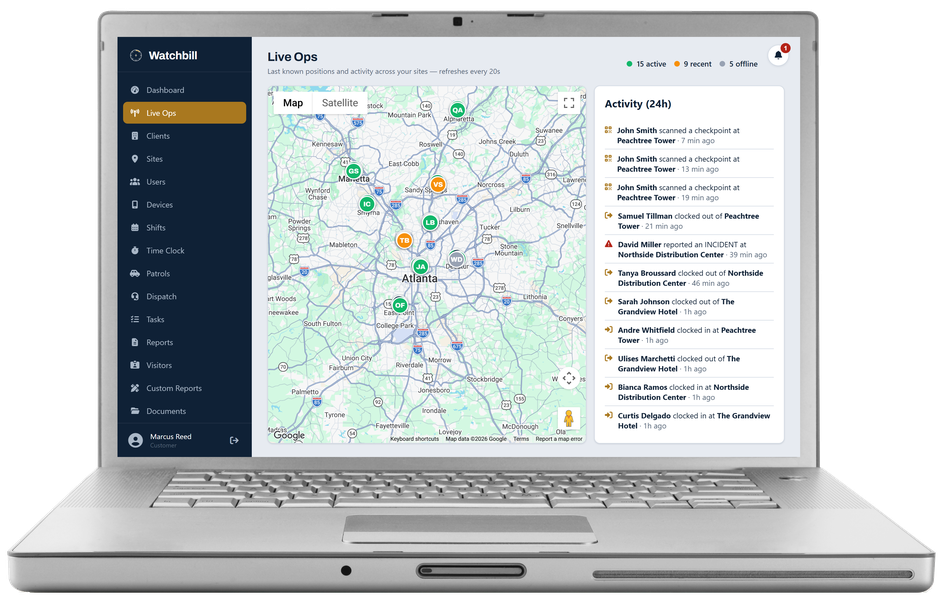
Live map: every guard's last verified position
One map with every guard's last position from work events — clock-ins, checkpoint scans, patrol stops, report submissions and live on-shift pings — plus site pins, active SOS alerts in red, and a rolling activity feed. Green means clocked in with a fresh position; amber means recent activity but not on the clock. Nobody is tracked off shift, and the app tells guards so.
Dispatch with a response-time trail
A client calls about an alarm. Create the call, press Assign, and the dialog has already ranked who should go. The guard gets a push, and from their app the call moves Assigned → En route → On scene → Resolved, each step logged with who, when, a note and GPS. Received 22:14, en route 22:16, on scene 22:24, resolved 22:31 — that is the response-time accountability clients ask for and most companies can't produce.
Who's nearest, worked out for you
The Assign dialog ranks every guard and supervisor for the call: on duty first, then by distance from the call's site to their last known position — the same clock-ins, scans and pings the live map uses — then by how many open calls they already hold. Each row says where they are posted, how far away, how fresh the position is, and has its own Assign button. Mike, on duty at the warehouse next door, 320 m, seen two minutes ago, is at the top; the guard who clocked out an hour ago is at the bottom.
It is a suggestion, not an auto-assignment. Nothing happens until the dispatcher presses the button, and the full list is still there for the judgement calls a ranking can't make — the nearest guard may be the one who must not leave their post.
Response targets you can prove
Set the response-time promise per priority — a guard assigned within 5 minutes and on scene within 20 for an urgent call, say — as company defaults, and override them per client where the contract differs. Every dispatch call gets its deadlines the moment it is received and shows a live countdown on the board: green with time to spare, amber inside the warning window, red once missed.
A warning goes to the site's supervisors before a target is missed; a miss is recorded on the call and announced; and if nobody has picked it up after your escalation delay, every owner hears. The Response times report then says what a property manager asks at renewal: 96% of urgent calls on scene within target, average 11 minutes, and here are the four that missed.
Job types, and the report each one requires
Alarm response, medical assist, noise complaint, escort, suspicious person — define the kinds of call your office takes. Each sets a default priority, can carry its own response targets and short instructions the responder sees on the call ("do not enter a forced door alone"), and — the part that matters at renewal — the report a call of that kind must have before it can be closed: an incident report, or one of your own forms.
On the officer's phone, Resolve on such a call offers Write it now: the report opens pre-filled with the site and the call, and submitting it closes the call and attaches the report to it. A draft the officer never sent does not count. The office can still close a call without its report, but only for a reason, which goes on the timeline. Analytics then shows, per job type, how many calls required a report and how many had one.
SOS that pages everyone, always
One tap sends the guard's name, site, live GPS and an optional message to every office user and supervisor, and flashes red on the map. Someone acknowledges — the guard sees "help is on the way" — and later resolves with an outcome note. Only the guard can cancel their own alert (recorded as a false alarm). SOS is never blocked, even if the subscription has lapsed.
Messaging that is a company record
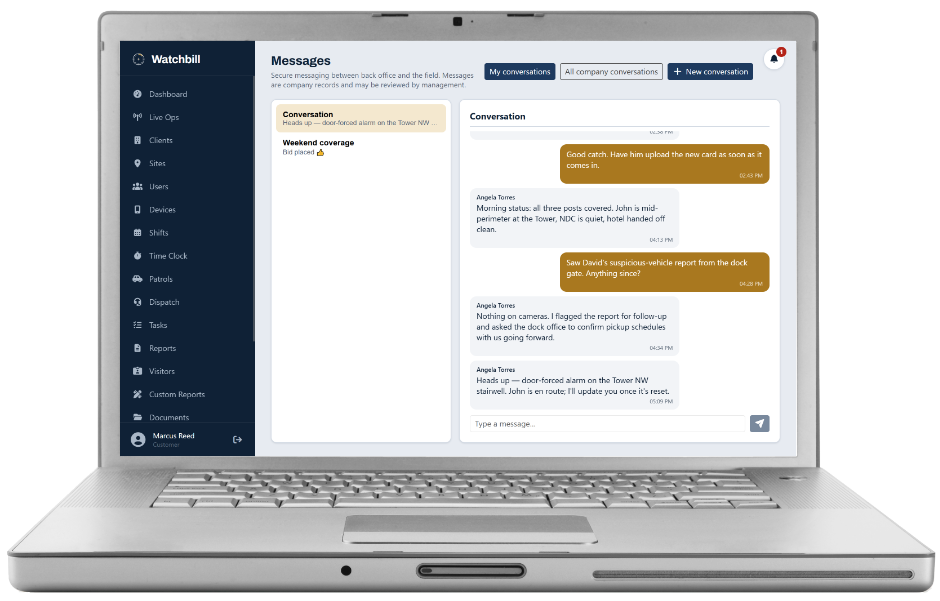
Direct and group threads between the office and the field, with push notifications and unread badges. Clients are excluded by design. Messages are business records: the account owner has a read-only view of all company conversations — it never marks anything read and never lets the owner post into a thread they aren't in — and the apps say so on the messaging screen. When a guard says he reported the broken gate at 22:40, here's the thread. Watchbill staff can never read your messages.
Visitors, tasks and the notifications that tie it together
A digital gate log: expected arrivals with one-tap check-in, walk-ins with ID type and last four, photos, plates, badges, denials with a reason, and a searchable history clients can read for their own sites. Anyone still shown on site at end of day is closed out and visibly flagged.
Tasks are one-off jobs assigned to a person — "confirm the light in Lot C is fixed", due Friday, photo required — that flip to Overdue on their own.
And the notification bell and push carry everything that needs a human: submitted incidents, missed shifts and tours, late arrivals, guards leaving a site, silent phones, unanswered welfare checks, SOS, dispatch assignments, under-target patrols, expiring licenses. A Devices page shows every phone's app version and permission state, for the day someone says "I never got it."
Questions owners ask
Can supervisors see every guard?
Supervisors see guards who share their assigned sites. Owners see everyone.
Do clients get access to the map or chat?
No. The client portal shows approved reports, patrol visits, visitors and documents for their sites — never location, scheduling or messages.
Is there a phone version?
Yes — the Command app has the live map, dispatch, SOS response, report approvals and messaging, with the same account as the web.
Does dispatch pick the guard automatically?
No. It ranks guards by on-duty status and distance from the call and shows you why; a person assigns. Distances are straight-line from the last known position, not drive time.
What if a call is resolved by phone and no report is needed?
Give the job type no report requirement, or close the call from the office with a reason. The reason is recorded on the call; guards cannot waive it.
Put one shift on the map
Free 30-day trial with no card required. Start with one site and add the rest when you're ready.
Start free trial Request a demo